- Is there any sense in which Lee’s work could be considered voyeuristic or even exploitative? is she commenting on her own identity, the group identity of the people she photographs, or both?
Nikki S. Lee transforms herself into someone else, to fit into a group of other people from different social/ethnic backgrounds.
I think a lot of people viewing Lee’s work will think it is exploitative. However I would disagree. I am interested to know how Lee asks people to be involved in her project, but I know she doesn’t force them or take advantage. If the participants felt uncomfortable in anyway, surely they wouldn’t continue with the shoot and the project. Therefore, those that have taken part are relaxed and happy.
I am unsure whether she is commenting on her own identity as she is putting herself in others shoes. However, I do get the feeling that maybe she is trying to find herself? maybe she is confused with her own identity? This is obviously my own opinion on her work.
I do think she comments a lot on the groups identity. She does this in a way to raise awareness within her different projects. This way, her as the photographer and the participants are both gaining something.
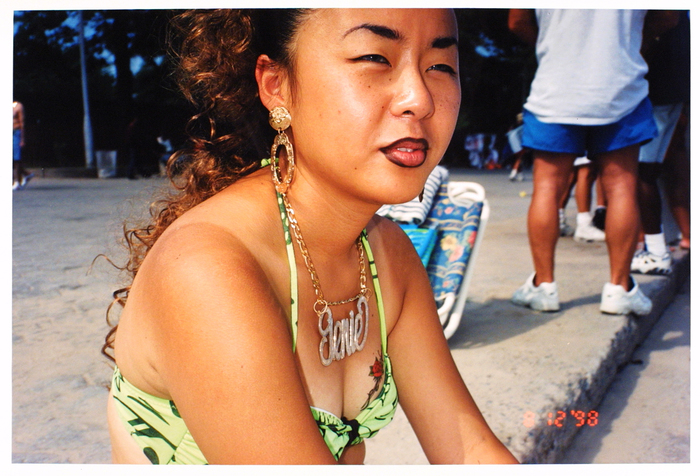
The Hispanic project 1998
- Would you agree to Morrissey’s request if you were enjoying a day on the beach with your family? if not, why not?
I would absolutely! Sounds like a lot of fun, although I wouldn’t have the confidence to do what Morrissey did, going around asking to swap clothing and take their place. But if she was friendly and explained her intention I would definitely take part. Maybe because I’m a photographer?
Although to have a ‘fake’ family photograph out there, being so close to my loved ones would be very strange and would probably make viewers (as well as my family) feel quite uneasy. However, I also think this is what makes this series so interesting.
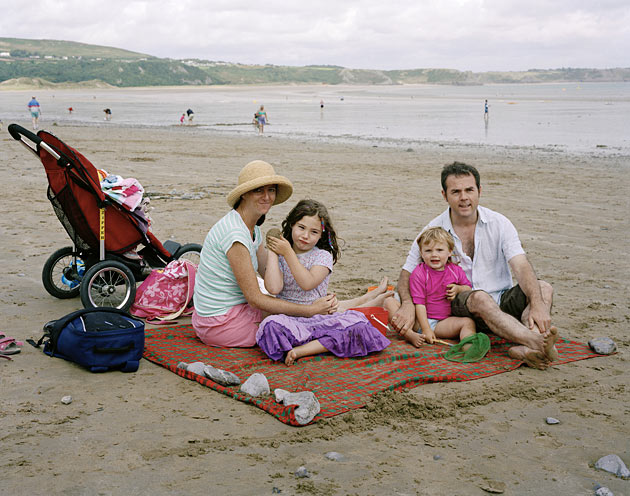
Sylvia Westbrook, August 2nd, 2005
- Morrissey uses self-portraiture in more of her work, namely Seven and The Failed Realist. Look at these projects online and make some notes in your learning log.
Morrisey’s work Seven Years (2001-2004), in which the title refers to the gap between Morrisey and her elder sister, is a collaboration with her sister where they both recreate family memories.
This work is similar to her series Font, however, much more personal to her as she it is her family.
These memories were from the 1970s and 1980s so Morrissey uses clothing and props to portray that time period. I am not sure whether she has edited her photo’s or whether it is just the clothing and props, but the images really do have that ‘old family photo’ feel to them.
In each image, both Morrissey and her sister are taking a different role, both male and female are portrayed. The use of body language is well executed and shoes the psychological tension between family relations.
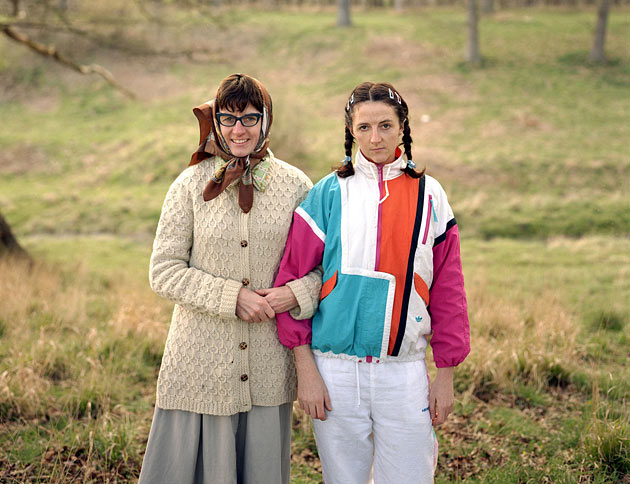
September 20th, 1985
I really enjoyed looking at Morrisey’s work The Failed Realist. It has given me a few ideas for future assignments with my daughter who has additional needs.
Morrisey collaborated with her daughter for this series. Her daughter was between the ages of four and five yours year when face painting was something she really enjoyed. She painted something on Morrisey’s face from her immediate experience, such as a movie or an event.
Between the ages of four and six, children are often more verbally articulate rather than visually. This means expressing themselves through mark marking can be beyond their physical ability. The Psychologist Georges-Henri Luquet (1927/2001) called this The Failed Realist Stage.
Beyond the innocence of the child’s intention, more sinister themes such as clowns, carnival and the grotesque are evoked by these mask like paintings.
Trish Morrisey
This quote caught my intention. I hadn’t seen her images in this way. However, looking back through them, I can see why she thought this.
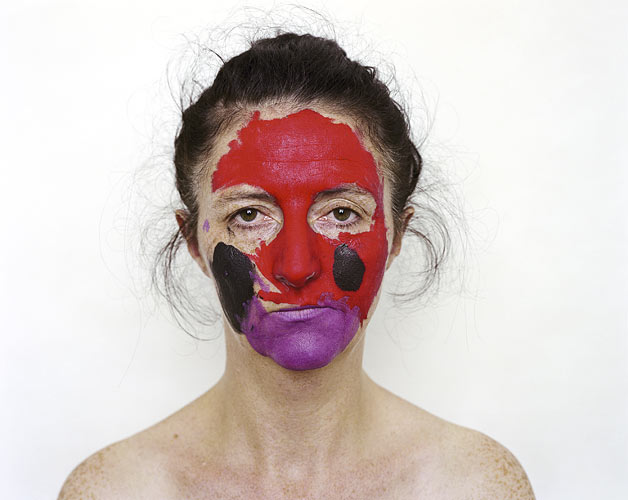
Ladybird (2011)
Bibliography
https://www.icp.org/browse/archive/objects/the-hispanic-project-25 [Accessed 05/07/20]
http://www.trishmorrissey.com [Accessed 05/07/20]

 Amianne Riggott OCA Blog